


Why Leaf Size Matters in Swiss Cheese Plants
The Swiss Cheese Plant (Monstera Deliciosa) is celebrated for its dramatically large, deeply fenestrated leaves — the bigger and more split the leaves, the healthier and more impressively established the plant. Leaf size is a direct reflection of the energy the plant has available to invest in growth. Large, complex leaves with fenestrations require enormous amounts of photosynthetic energy to produce. When that energy is limited — by insufficient light, poor nutrition, root stress, or environmental factors — the plant responds by producing smaller, simpler leaves that cost less energy to make.
In UAE homes, several specific factors commonly combine to produce this small-leaf problem — many of which are entirely fixable once identified.
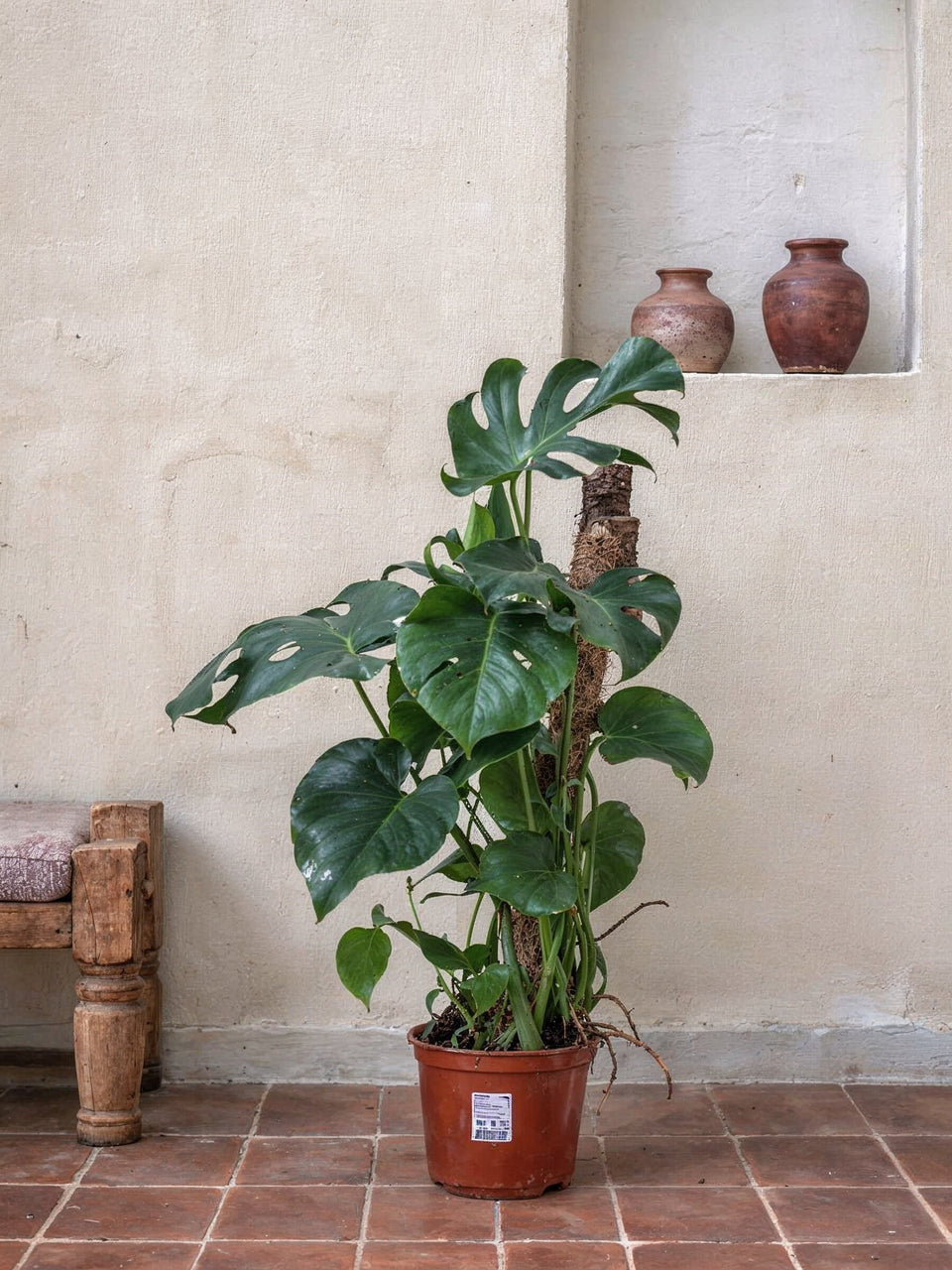
Reason 1 — Insufficient Light
This is the single most common cause of small leaves in Swiss Cheese Plants — and the most impactful to fix. Light is the primary energy source for all plant growth, and the Swiss Cheese Plant needs substantial amounts of it to produce its characteristically large, fenestrated leaves.
A Monstera receiving inadequate light simply does not have the photosynthetic energy budget to produce large complex leaves. It responds by producing smaller, thinner, lighter-coloured leaves that cost less energy — a sensible survival strategy that is unfortunately the opposite of what plant owners want.
In UAE apartments — particularly those with north-facing windows, interior rooms set back from windows, or windows partially shaded by neighbouring buildings — insufficient light is a genuine and extremely common issue. The plant survives but does not thrive with the energy surplus needed for impressive leaf production.
The Swiss Cheese Plant needs bright indirect light — the kind found within 1–2 metres of an east or west-facing window — for at least 6 hours daily. If you are seeing small leaves and the plant is not near an adequate light source, this is almost certainly the primary cause.
The fix: Move progressively closer to a bright window over 1–2 weeks to avoid light shock. An east-facing window receiving strong morning light is ideal for UAE conditions. For genuinely dark apartments, a dedicated full-spectrum LED grow light running 10–12 hours daily produces dramatic results — most plant owners see noticeably larger new leaves within 2–3 leaf cycles of improving light conditions.
Reason 2 — The Plant Needs to Climb
This is one of the most fascinating causes of small leaves — and one that directly reflects the Swiss Cheese Plant's natural biology. In its native Central American rainforest habitat, the Monstera is a climbing vine that ascends tree trunks upward toward stronger light. As it climbs higher, it produces progressively larger and more fenestrated leaves. A plant growing horizontally along the ground — or sprawling unsupported in a pot — behaves differently from one climbing vertically, and this difference shows clearly in leaf size.
A Monstera supported on a vertical moss pole and actively climbing tends to produce significantly larger leaves than the same plant growing without support. The upward orientation, improved light access at each new growing point, and the stimulus of aerial roots attaching to the pole all trigger the plant's mature, large-leaf growth behaviour.
The fix: Install a moss pole in the pot and train the main stem to climb it. Keep the pole moist by misting or watering it during your regular care routine — this encourages aerial roots to attach firmly. Within a few leaf cycles, most UAE plant owners see noticeably larger new leaves emerging.
Reason 3 — Underwatering or Overwatering
Both extremes of watering produce small leaves — through different mechanisms.
Underwatered plants lack the water pressure needed to expand leaf cells to their full size as new leaves develop. Leaves that unfurl in a drought-stressed plant simply cannot expand to the size they would in adequate moisture conditions.
Overwatered plants develop root damage that prevents efficient water and nutrient transport to developing leaves. A plant with compromised roots cannot supply the resources needed for large leaf development, resulting in the same small, underwhelming output despite apparently adequate care.
In UAE homes, overwatering is far more common than underwatering — air conditioning dramatically slows soil evaporation, creating persistently wet conditions that gradually damage the root system.
The fix: Always check soil moisture at 5cm depth before watering. The Swiss Cheese Plant needs water when the top 3–5cm of soil is dry — typically every 7–14 days in UAE summer. Ensure the pot has adequate drainage holes and the soil mix includes perlite for good drainage.
Reason 4 — Nutrient Deficiency
Producing large, complex leaves is a nutritionally demanding process. A Swiss Cheese Plant in depleted soil — particularly one that has not been fertilised for an extended period or has been in the same potting mix for more than 18 months — lacks the macro and micronutrients needed for ambitious leaf production. The plant defaults to producing smaller leaves that require fewer resources.
In UAE homes where regular soil flushing is recommended to manage hard tap water mineral buildup, nutrient leaching is a real consideration. Flushing removes accumulated minerals — but also removes available nutrients.
The fix: Feed with a balanced liquid fertiliser at half strength, once monthly during the UAE growing season (March to October). Never fertilise in winter when the plant is resting. If the plant has been in the same soil for more than 18 months, repotting into fresh nutrient-rich potting mix is the most comprehensive solution.
Reason 5 — Low Humidity From UAE Air Conditioning
The Swiss Cheese Plant evolved in humid tropical rainforests where air humidity regularly exceeds 70%. UAE air conditioning routinely drops indoor humidity to 20–30% — a significant mismatch that affects all aspects of the plant's development, including leaf size.
In very dry conditions, the plant prioritises water conservation over leaf expansion. New leaves may unfurl but fail to reach their full potential size because the plant is managing moisture stress simultaneously with growth. The resulting leaves are smaller, less impressive versions of what the plant is capable of producing.
The fix: Add a pebble humidity tray beneath the pot using pebbles from GrowHub's gravel and pebbles collection. Group your Swiss Cheese Plant with other indoor plants to create a shared humidity microclimate. For plants producing persistently small leaves in very dry UAE apartments, a small room humidifier maintained at 50–60% humidity produces the most significant improvement in leaf size.
Reason 6 — Root Bound Conditions
A Swiss Cheese Plant that has completely filled its pot with roots has limited capacity for vigorous above-ground growth — its energy is consumed managing a cramped root environment rather than producing large new leaves. Signs of root binding include roots emerging from drainage holes, roots circling visibly at the soil surface, and soil drying out unusually fast after watering.
The fix: Repot in early spring (March in UAE) into a container 2–3cm wider than the current pot using fresh, well-draining potting mix. The combination of fresh soil nutrients and expanded root space typically triggers a noticeable improvement in leaf size within the following growing season.
Reason 7 — Environmental Stress and Frequent Moving
The Swiss Cheese Plant is a creature of habit. Frequent repositioning — moving it from room to room, changing its light exposure regularly, or placing it near AC vents — creates ongoing acclimatisation stress that diverts energy away from leaf production. A stressed, frequently moved Monstera produces smaller leaves as it constantly adjusts to new conditions rather than investing in growth.
The fix: Choose a permanent position with consistent bright indirect light, stable temperature, and distance from AC vents — then leave the plant there. Consistency is the key to large leaf production. The more stable the environment, the more energy the plant can direct toward producing the large, impressive leaves it is capable of.
Reason 8 — UAE Tap Water Mineral Damage
UAE tap water contains fluoride, chlorine, and dissolved mineral salts that accumulate in the soil with every watering and are absorbed through the roots. Over time this compromises root health and nutrient absorption efficiency — producing a plant that is technically being watered and fed but cannot fully utilise those resources for leaf production.
The fix: Switch to distilled water, RO-filtered water, or collected AC condensate. Flush the existing soil thoroughly with distilled water every 2–3 months to remove accumulated mineral deposits from the root zone.
Quick Diagnosis Guide
| Symptom | Most Likely Cause |
|---|---|
| Small leaves throughout, dim location | Insufficient light — primary cause |
| Small leaves despite good light | Needs moss pole support to climb |
| Small pale leaves, slow growth | Nutrient deficiency — fertilise |
| Small leaves, wet soil | Overwatering — reduce watering |
| Small leaves, crispy edges | Low humidity or underwatering |
| Small leaves after repotting | Temporary adjustment — normal |
| Small leaves, roots at drainage holes | Root bound — repot immediately |
Final Thoughts
Small leaves on a Swiss Cheese Plant are never permanent — they are a response to conditions that can almost always be improved. Light is the first thing to address, climbing support is the second, and everything else follows from there. Make these changes consistently and patiently, and your Monstera will reward you with the dramatic, large fenestrated leaves it is genuinely capable of producing.
🌿 Browse GrowHub's full indoor plants collection — healthy, UAE-suited Swiss Cheese Plants and other indoor plants delivered across Dubai and Abu Dhabi.
🪨 Shop pebbles for humidity trays — raise humidity around your Swiss Cheese Plant to support larger, healthier leaf development in UAE AC environments.


