


1. NASA Ranked It Among the Top 3 Air-Purifying Plants in the World
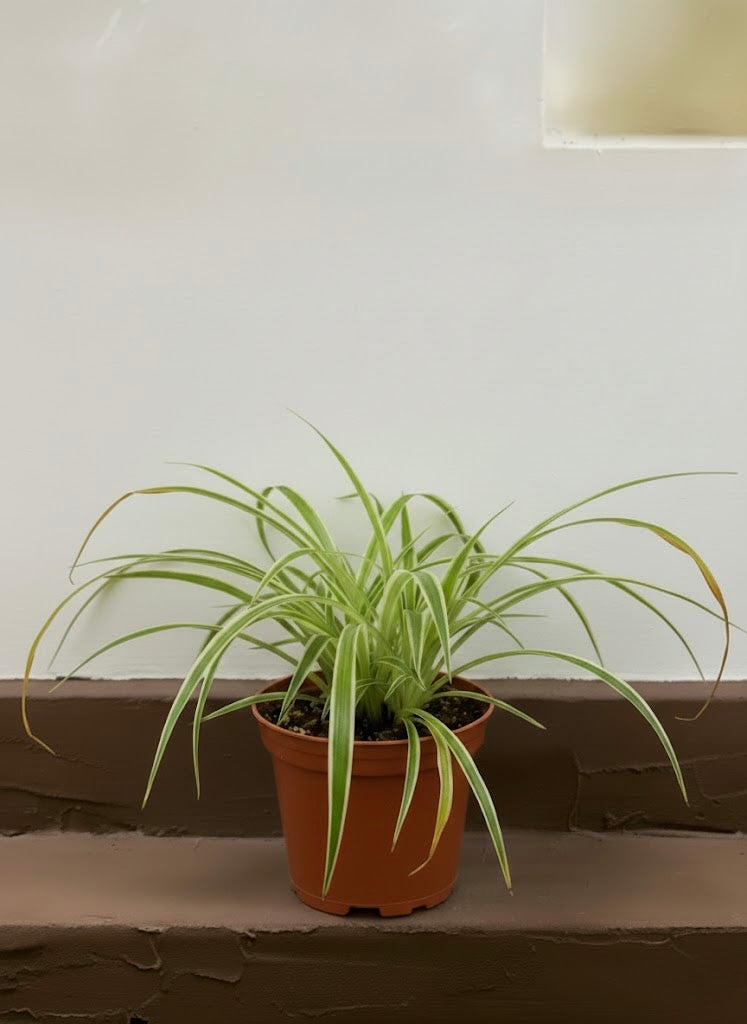
Most people know the Spider Plant (Chlorophytum comosum) is supposed to clean the air — but very few know just how highly it ranked. In NASA's landmark Clean Air Study, the Spider Plant was placed among the top three houseplants for removing formaldehyde from indoor air. In controlled tests, Spider Plants removed 95% of formaldehyde from a sealed chamber within just 24 hours — outperforming the majority of other plants tested.
Beyond formaldehyde, Spider Plants also absorb xylene, toluene, benzene, and carbon monoxide — a broad range of the volatile organic compounds (VOCs) that accumulate in modern UAE homes from furniture, cleaning products, paint, and air conditioning systems.
2. It Can Remove Carbon Monoxide — A Genuinely Dangerous Gas
While most air-purifying plant discussions focus on VOCs and formaldehyde, the Spider Plant's ability to absorb carbon monoxide sets it apart. Carbon monoxide is an odourless, colourless gas produced by gas appliances, generators, and combustion — and even in small concentrations it is harmful to human health. The Spider Plant is one of only a handful of commonly available houseplants documented to absorb this gas from indoor air — a practical benefit that goes well beyond aesthetics.
3. It Has Been Proven to Speed Up Hospital Recovery
A study by researchers at Kansas State University found that surgical patients in rooms containing Spider Plants recovered measurably faster than patients in rooms without plants. The plant-exposed patients required less pain medication, experienced lower blood pressure and heart rate issues, showed reduced anxiety and depression, and were discharged from hospital sooner. The combination of air purification and the psychological calming effect of greenery produced measurable physiological benefits — making the Spider Plant genuinely therapeutic, not just decorative.
4. The Babies Are Genetically Identical Clones
The small plantlets — commonly called "spiderettes" or "babies" — that dangle on long stems from a healthy Spider Plant are not seeds or offspring in the conventional sense. They are genetically identical clones of the parent plant, produced through a process called vegetative propagation. Each spiderette is a complete, fully functional plant that can be detached and rooted to produce a new plant — meaning a single Spider Plant can produce dozens of identical offspring throughout its lifetime.
This is also why Spider Plants are one of the easiest houseplants to propagate — no specialist equipment, no rooting hormone, no special skill required. Simply place a spiderette in water or moist soil and it roots reliably within weeks.
5. It Produces More Babies When Slightly Stressed
One of the most counterintuitive facts about Spider Plants is that they produce the most spiderettes when they are slightly — but not severely — stressed. A plant that is slightly pot-bound, receiving slightly reduced watering, or experiencing slightly cooler temperatures is stimulated to reproduce more aggressively. This is a survival mechanism — the plant senses conditions that suggest its environment may become less favourable and responds by producing offspring to increase the chances of the species surviving.
In UAE homes, this explains why Spider Plants on shelves in slightly smaller pots with indirect light often produce more babies than lavishly potted, heavily watered specimens in prime window positions.
6. It Is One of the Very Few Indoor Plants That Is Genuinely Pet-Safe
The Spider Plant is listed as non-toxic to both cats and dogs by the ASPCA — a distinction that very few popular houseplants share. Pothos, Peace Lily, ZZ Plant, Snake Plant, and Monstera are all toxic to pets to varying degrees. The Spider Plant is genuinely safe — even if a curious cat chews on the leaves, there is no toxicity concern.
There is one small caveat worth knowing: Spider Plants contain compounds that produce a mild hallucinogenic effect specifically in cats — similar in mechanism to catnip — which is why some cats are particularly attracted to them. The effect is mild, temporary, and harmless — but it does explain why cats may seek out Spider Plants more actively than other houseplants.
7. It Can Grow Entirely in Water — Indefinitely
Like the Money Plant, the Spider Plant is one of the few houseplants that can be grown in water alone as a permanent display — not just for propagation. A healthy Spider Plant spiderette placed in a clean glass vase of water will root, establish, and continue growing indefinitely without any soil. The roots adapt to water growing and the plant maintains healthy leaf production — making it one of the most versatile indoor plants for UAE apartment owners who prefer mess-free, soil-free displays.
Use distilled water or AC condensate rather than UAE tap water for water-grown Spider Plants — the fluoride and mineral salts in UAE tap water cause the brown tips that are already the most common Spider Plant complaint when grown in soil.
8. Its Leaves Are Edible
This is perhaps the most surprising fact of all. Spider Plant leaves are edible — they have been consumed as a vegetable in parts of Africa, where the plant originates, for generations. The leaves are not commonly eaten in most of the world, but they are non-toxic to humans and have been used in traditional cooking. This does not make them a recommended food source — but it does underline just how completely safe this plant is for households with children and pets.
9. It Thrives in UAE Air Conditioning Better Than Almost Any Other Tropical Plant
Most tropical houseplants struggle with UAE air conditioning — the cold, dry air causes brown tips, curling leaves, and humidity stress that requires active management. The Spider Plant is a notable exception. It is naturally more tolerant of dry air and temperature fluctuations than most of its tropical counterparts, making it one of the most genuinely suited indoor plants for UAE apartments where AC runs year-round.
Its main sensitivity in UAE homes is fluoride in tap water — switching to distilled water or AC condensate is the single most impactful care change UAE Spider Plant owners can make. With clean water, good indirect light, and basic attention, a Spider Plant in a Dubai apartment can thrive for years with minimal intervention.
Browse GrowHub's Spider Plant — one of the most UAE-suited indoor plants available.
10. It Is One of the Fastest Self-Propagating Plants in the World
A healthy, mature Spider Plant can produce dozens of spiderettes in a single growing season — and each spiderette can be rooted and become a productive plant within weeks. A single Spider Plant purchased today can realistically become 10–20 plants within one year, and 50–100 plants within two years, through simple propagation. This extraordinary reproductive rate is why the Spider Plant has become one of the most widely distributed houseplants in the world — passed between friends, neighbours, and families as cuttings for generations.
In the UAE plant community, Spider Plants are frequently shared and gifted as spiderettes — making them one of the most generously propagated plants in Dubai and Abu Dhabi households.
🌿 Shop the Spider Plant at GrowHub — healthy, UAE-suited Spider Plants delivered across Dubai and Abu Dhabi.
🪨 Add decorative pebbles as a top dressing — prevents fluoride-damaged soil buildup and gives your Spider Plant display a beautifully polished finish.


