


Why Leaning Is Significant for Fiddle Leaf Figs
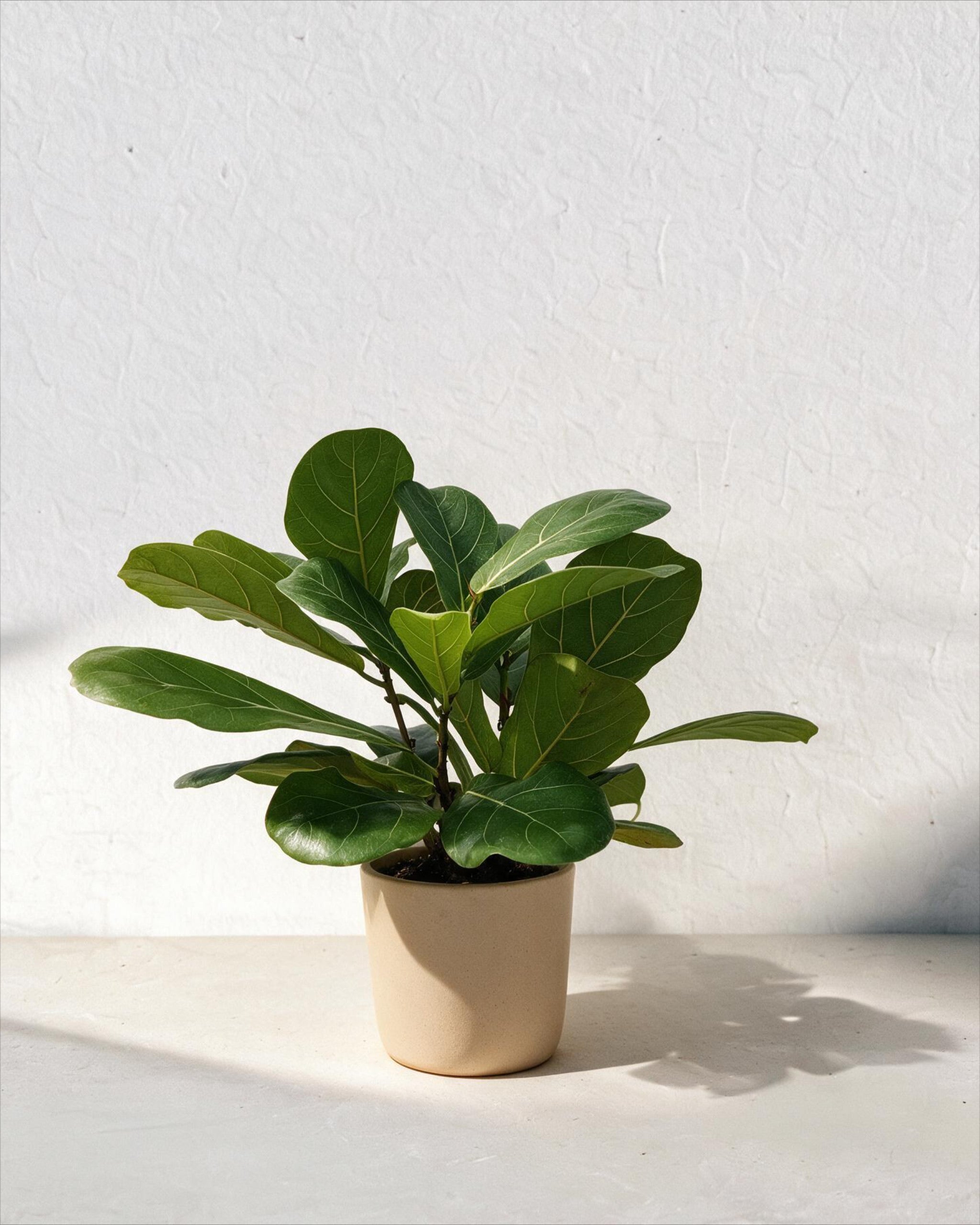
The Fiddle Leaf Fig (Ficus lyrata) naturally grows as a tall, upright, single-trunk tree in its native West African rainforest habitat — reaching 12–15 metres in height with a strong, vertical central trunk. Its indoor form aims to replicate this upright, architectural quality — the characteristic that makes it one of the most striking statement plants available for UAE home interiors.
When a Fiddle Leaf Fig begins leaning, it is not simply an aesthetic issue. The lean indicates a specific environmental pressure or structural problem that, if unaddressed, will continue until the lean becomes so pronounced that the plant risks toppling, the trunk develops a permanent curve that cannot be corrected, or the structural root system is stressed by the weight imbalance.
Identifying the cause early — when the lean is still mild — makes correction significantly easier than addressing a severely leaning, established curve.
Cause 1 — Uneven Light (Most Common UAE Cause)
The most common cause of Fiddle Leaf Fig leaning in UAE apartments is directional light — the plant growing toward its primary light source and developing a pronounced lean in that direction over time. This biological process is called phototropism — the plant's cells on the shaded side grow slightly longer than those on the lit side, causing the stem to curve toward the light source progressively with each new growth cycle.
In UAE apartments where windows are typically concentrated on one side of the apartment, a Fiddle Leaf Fig that is not regularly rotated develops an increasingly pronounced lean toward the window over weeks and months. Given the Fiddle Leaf Fig's sensitivity to being moved — it drops leaves when relocated — many UAE owners leave it in the same position indefinitely, allowing the phototropic lean to become increasingly severe.
The fix: Rotate the plant a quarter turn every 2 weeks — in place, without moving it to a new position. This distributes the light exposure evenly across all sides of the plant, preventing new phototropic lean from developing. For an existing lean, rotation gradually encourages growth back toward vertical over several months as the previously shaded side now receives more light and its cells elongate more to compensate.
Important UAE caveat: Fiddle Leaf Figs are notorious for dropping leaves when moved to new positions — but rotation in the same location without changing the plant's environmental conditions does not trigger the same stress response. Rotate without repositioning for the safest correction approach.
Cause 2 — No Structural Support for a Tall, Top-Heavy Plant
As Fiddle Leaf Figs mature and develop their characteristic large, heavy leaves on a relatively slender trunk, the weight of the upper canopy can exceed what the trunk can support vertically without mechanical assistance. This is particularly relevant in UAE apartment conditions where the plant grows rapidly during the March to October growing season and may develop a large, heavy leaf cluster on top of a trunk that has not yet developed the structural wood density to support it upright.
Fiddle Leaf Figs in their natural habitat develop strong trunks through wind — the physical movement of the trunk in wind stimulates the development of stronger, denser wood tissue. In sealed UAE apartments with no wind movement and consistent AC conditions, this natural trunk-strengthening process does not occur — leaving the plant structurally weaker than an equivalent outdoor specimen.
The fix: Install a bamboo stake or support pole in the pot beside the leaning trunk and tie the trunk to the stake using a soft plant tie at 2–3 points along the trunk length. This provides immediate mechanical support while the trunk develops greater structural density. Additionally, practice the wobble method — gently moving the trunk back and forth for 30 seconds twice weekly — which mimics the wind stimulation that triggers trunk strengthening in the plant's natural habitat.
Cause 3 — Root Rot Causing Structural Instability
A Fiddle Leaf Fig leaning with a soft, discoloured trunk base — particularly one whose soil has been consistently moist or wet in UAE's slow-drying AC conditions — may be experiencing root rot that has progressed to the lower trunk. Rotted roots cannot anchor the plant firmly in the soil, and the loss of structural root anchorage causes the heavy upper canopy to pull the plant into a lean.
This is the most urgent lean cause — root rot is progressive and every day of delay allows it to advance further toward the trunk's central tissue.
The fix: Remove from the pot immediately. Inspect the root system — trim all brown, mushy root tissue with sterilised scissors. Allow the cleaned root ball to air dry for 2–3 hours. Repot in completely fresh, well-draining potting mix with 30% perlite in a terracotta pot. Stake for support during recovery. Do not water for 7–10 days after repotting. In UAE conditions, always check soil at 5cm depth before every watering — the finger test prevents the chronic overwatering that creates root rot in the first place.
Cause 4 — Asymmetric Watering Creating Uneven Root Growth
Consistently watering from the same side of the pot — always pouring water at the same point rather than distributing evenly across the soil surface — creates a moisture gradient within the root zone where roots grow more densely toward the consistently wetter side. This asymmetric root development gradually pulls the plant's weight distribution toward the more heavily rooted side, causing a lean in that direction over months.
This is one of the less obvious UAE Fiddle Leaf Fig lean causes — it develops slowly and without any of the dramatic visible symptoms that other causes produce alongside the lean itself.
The fix: Switch to bottom watering — place the pot in a basin of distilled water for 20–30 minutes and allow the soil to absorb moisture evenly from below. This provides completely even moisture distribution throughout the root zone and eliminates the directional moisture gradient that causes asymmetric root growth. After switching to bottom watering, the existing root asymmetry will gradually self-correct over several months as previously under-watered roots develop into the newly accessible moisture.
Cause 5 — Pot Too Small or Too Light
A mature Fiddle Leaf Fig with a large leaf canopy in a small or lightweight pot will lean — and eventually topple — simply because the pot cannot counterbalance the weight of the upper plant. This is particularly common in UAE homes where decorative lightweight ceramic or plastic pots are chosen for aesthetic reasons without considering whether they provide sufficient base stability for a large, maturing Fiddle Leaf Fig.
The fix: Repot into a heavier, wider-based pot — terracotta is ideal for UAE conditions for both its weight and its moisture management properties. A pot that is 4–6cm wider than the current root ball provides significantly more stable counterbalance for a large Fiddle Leaf Fig than the standard 2–3cm upgrade. Adding a layer of heavy pebbles from GrowHub's gravel and pebbles collection on the soil surface lowers the centre of gravity and improves stability further.
Quick Diagnosis and Fix Summary
| Lean Pattern | Most Likely Cause | Fix |
|---|---|---|
| Lean toward window | Directional light | Rotate quarter turn every 2 weeks |
| Top-heavy lean, slender trunk | No structural support | Bamboo stake + wobble method |
| Lean with soft trunk base | Root rot | Emergency repotting immediately |
| Lean toward one side, watered from same spot | Asymmetric watering | Switch to bottom watering |
| Plant tipping in lightweight pot | Pot too small or light | Repot into heavy terracotta |
🌿 Browse GrowHub's full indoor plants collection — including Fiddle Leaf Figs delivered across Dubai and Abu Dhabi.
🪨 Shop pebbles for stability and top dressing — lower the centre of gravity of your Fiddle Leaf Fig pot and complete your display beautifully.


