


Fenestration — The Scientific Term for Monstera's Holes
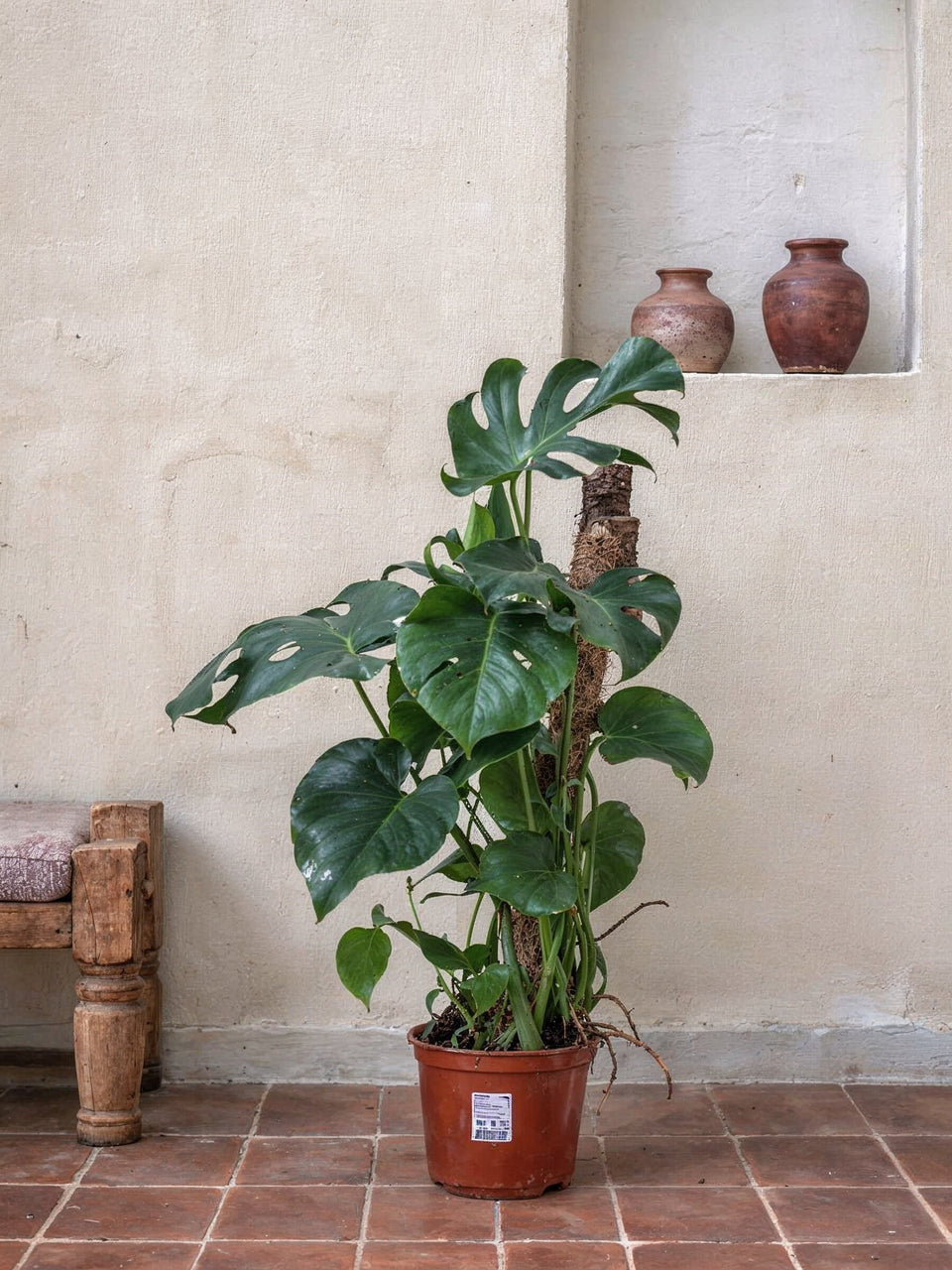
The botanical term for the natural holes and splits found in Swiss Cheese Plant leaves is fenestration — derived from the Latin word fenestra, meaning window. The technical term for plants creating holes or clear sections in their leaves is leaf fenestration, and this phenomenon is not unique to Monstera alone.
What makes the Swiss Cheese Plant (Monstera deliciosa) remarkable is how prominently and dramatically it displays this trait compared to virtually any other commonly grown houseplant. Fenestration is genuinely rare in the plant kingdom — fewer than 0.5% of all flowering plant species exhibit it — and Monstera is among the most extensively studied examples of the phenomenon. This rarity is precisely why the Swiss Cheese Plant has captured global fascination as a houseplant — its leaf structure is doing something genuinely unusual in evolutionary terms.
Where Fenestration Comes From — The Rainforest Origin
To understand why these holes exist, you need to understand where the Swiss Cheese Plant comes from. Monstera deliciosa and its close relatives originate in the humid, layered canopies of Central and South American rainforests, where sunlight is scarce, fragmented, and highly directional — filtering through gaps in the dense upper canopy in fleeting, shifting beams.
In this environment, the plant begins its life on the dark forest floor as a seedling, surrounded by competing vegetation and deprived of consistent direct light. As the plant grows and matures, it begins to climb and attach to tree trunks, ascending toward the canopy in search of sunlight. This climbing journey — sometimes taking years to reach meaningfully brighter conditions — is the central evolutionary pressure that shaped the development of fenestrated leaves.
The Leading Scientific Theory — Light Capture Through "Sunflecks"
The most widely accepted explanation among botanists today centres on a phenomenon called sunflecks — the brief, intense, constantly shifting patches of direct sunlight that penetrate through small, temporary gaps in a dense rainforest canopy as leaves above sway in the wind.
A solid, broad leaf in this environment would be remarkably inefficient. A large unbroken leaf would intercept only a narrow band of light at any given moment, while expending significant biological resources to build and maintain dense tissue across its entire surface area. Instead, a fenestrated leaf functions like a biological net spread out to catch light — the holes allow sunflecks to pass through unimpeded, striking the lower leaves, stem, and aerial roots of the plant below.
This is the key insight: a leaf riddled with holes can spread the same amount of leaf tissue over a much larger total area than a solid leaf of equivalent mass. By distributing leaf material across a wider total area, fenestration increases the probability that small, fleeting beams of sunlight will strike usable photosynthetic tissue somewhere on the leaf.
The research backing this theory is genuinely compelling. A study published in the American Journal of Botany in 2019 found that mature, fully fenestrated Monstera plants achieved significantly greater net photosynthetic efficiency than equivalent unfenestrated foliage — providing measurable evidence that the holes are not incidental but actively beneficial to the plant's energy capture.
This theory was significantly developed by Christopher Muir, an evolutionary biologist who studied the Monstera's relationship to its light environment in detail, proposing that the lighting conditions of the rainforest understory were the primary evolutionary driver behind fenestration.
The Wind Resistance Theory — Surviving Tropical Storms
A second, complementary theory explains fenestration through the lens of physical survival rather than light capture alone. Central American rainforests experience powerful seasonal storms and consistently humid, wind-exposed conditions. A large, solid, unbroken leaf in these conditions behaves like a sail — catching wind forcefully and risking tearing, stem damage, or even uprooting the entire plant from its climbing position.
Biomechanical modelling research from the University of Costa Rica found that fenestrations reduce wind drag force on Monstera leaves by up to 45% compared to an equivalent solid leaf surface. The holes function similarly to the engineered openings in a suspension bridge truss — allowing air to pass through the structure rather than building up destructive pressure against a solid surface.
For a climbing plant like the Swiss Cheese Plant — which depends entirely on maintaining a secure grip via its aerial roots as it ascends toward the canopy — this structural resilience against storm damage is a genuinely significant survival advantage.
The Water Management Theory — Directing Rainfall to the Roots
A third explanation, less dominant in current research but still discussed among botanists, relates to water management in the rainforest's intense, frequent rainfall. A solid, broad leaf could potentially deflect heavy rainfall away from the plant's base, reducing the water reaching its root system — while standing water pooling on a solid leaf surface creates conditions favourable to fungal infection and rot.
Under this theory, the holes serve a dual water-management function — allowing rain to pass directly through the leaf to the stem and root zone below, while preventing the kind of water pooling on leaf surfaces that would otherwise promote fungal disease in the consistently humid rainforest environment.
Most contemporary botanists view the light-capture theory as the primary evolutionary driver, with the wind-resistance and water-management benefits as meaningful secondary advantages that reinforced the trait once it began to emerge.
Why Your Own Swiss Cheese Plant Might Not Be Splitting
Understanding the evolutionary purpose of fenestration directly explains why a young or improperly positioned Swiss Cheese Plant in a UAE home produces only solid, unsplit leaves. The biological signal that triggers fenestrated growth is specifically tied to the conditions the plant evolved to respond to — primarily age, light, and vertical support.
Without sufficient brightness, the plant lacks the energy to initiate the complex developmental process required for leaf fenestration. Without something to climb, it receives no biological signal that it has reached the life stage where producing large, fenestrated leaves provides a meaningful advantage.
Fenestration only occurs once a Monstera leaf is mature enough to grow beyond a typical leaf size — generally exceeding 12–15cm — which the plant will not achieve without adequate light and nutrition supporting that growth.
This is precisely why a young Swiss Cheese Plant purchased from a UAE nursery — still in its juvenile growth phase — produces entirely solid, heart-shaped leaves for its first one to two years, regardless of how well it is cared for. The plant has not yet reached the developmental stage, light exposure, or climbing behaviour that triggers fenestrated growth.
How to Apply the Science — Encouraging Fenestration in Your UAE Home
Once you understand the biological triggers behind fenestration, encouraging it in your own Swiss Cheese Plant becomes a matter of recreating the rainforest conditions that originally selected for the trait:
Provide bright, indirect light. Position your Swiss Cheese Plant within 1–2 metres of an east or west-facing window in your UAE home, receiving at least 6 hours of bright indirect light daily. This replicates the energy-rich light environment the plant needs to fund the construction of complex, holed leaf tissue.
Install a vertical climbing support. Providing a physical support structure such as a moss pole encourages the plant to enter its mature climbing phase — the combination of ample light and vertical support reinforces the biological signal that the plant is ready to produce its largest, most complex foliage. A moss pole from your local UAE garden supplier mimics the tree trunks the plant naturally climbs in the wild.
Maintain adequate humidity. Monstera plants thrive in high humidity, with levels between 60% and 80% considered ideal — significantly higher than the 20–30% that UAE air conditioning typically produces. A pebble humidity tray from GrowHub's gravel and pebbles collection helps bridge this gap in UAE indoor environments.
Be patient with age. No amount of optimised care accelerates fenestration in a genuinely juvenile plant. Most Swiss Cheese Plants require 2–3 years of consistent growth before producing their first fenestrated leaves — this is a biological timeline, not a care failure.
Why Existing Solid Leaves Will Never Develop Holes
A common misunderstanding is expecting an already-unfurled solid leaf to develop fenestrations over time as conditions improve. This does not happen. Fenestration patterns are determined entirely during the leaf's initial development inside the protective sheath before it unfurls — once a leaf has fully opened as solid tissue, its structure is permanently fixed. Improvements to light, humidity, and support conditions influence the next leaves the plant produces, not the leaves already growing.
This is why patience after making care improvements is essential — the visible results of better conditions only appear in subsequent growth cycles, typically over the following one to three new leaves.
Not All Monsteras Fenestrate the Same Way
It is worth noting that fenestration is species and cultivar-dependent — not every Monstera develops holes identically. Monstera adansonii is distinguished from Monstera deliciosa by having longer, tapering leaves with completely enclosed leaf holes, while Monstera deliciosa's leaf holes eventually grow toward the edge and open up as the leaf matures further. Meanwhile, other related species such as Monstera siltepecana remain largely whole-leaved throughout their growth, demonstrating that fenestration intensity varies considerably even within the same genus.
The Genuinely Remarkable Takeaway
What makes the Swiss Cheese Plant's leaf holes so scientifically fascinating is that they represent a rare case of a plant actively reducing its own leaf surface area — sacrificing photosynthetic tissue — in exchange for a more strategically distributed light-capturing structure, improved storm resistance, and better water management. It is not a defect or a random mutation that happened to persist. It is millions of years of evolutionary refinement, visible in real time on a plant sitting on a shelf in a Dubai apartment.
Every hole in every leaf is the product of the same evolutionary pressures that shaped this plant in the dense, competitive, storm-prone rainforests of Central America — now thriving, in a very different but no less successful form, in homes across the UAE.
🌿 Browse GrowHub's full indoor plants collection — including Swiss Cheese Plants and other UAE-suited indoor plants delivered across Dubai and Abu Dhabi.
🪨 Shop pebbles for humidity trays — recreate the rainforest humidity your Swiss Cheese Plant needs to support healthy fenestrated growth in UAE AC environments.
About GrowHub: GrowHub is the UAE's trusted online plant store delivering carefully selected houseplants, outdoor plants, accessories, and plant care products to homes and offices across Dubai, Abu Dhabi, and beyond. Free shipping on orders over AED 199.


