


The Origin of the Claim — NASA's Clean Air Study
In 1989, NASA researcher Dr. Bill Wolverton conducted a landmark study on the ability of indoor plants to remove volatile organic compounds (VOCs) from sealed indoor environments. The study was originally motivated by practical space exploration concerns — NASA needed to understand how to manage air quality in sealed spacecraft and space stations without conventional ventilation systems.
The results were striking. Several common indoor plants — including the Spider Plant — demonstrated measurable ability to remove specific pollutants from sealed test chambers. The Spider Plant in particular performed exceptionally well in removing formaldehyde, ranking among the top three plants tested. In controlled tests, Spider Plants removed approximately 95% of formaldehyde from a sealed plexiglass chamber within 24 hours — a result that generated enormous public interest and established the Spider Plant's enduring reputation as an air purifier.
The Spider Plant was also documented to absorb xylene, toluene, benzene, and carbon monoxide — a broad range of the indoor pollutants most commonly associated with health concerns in modern homes.
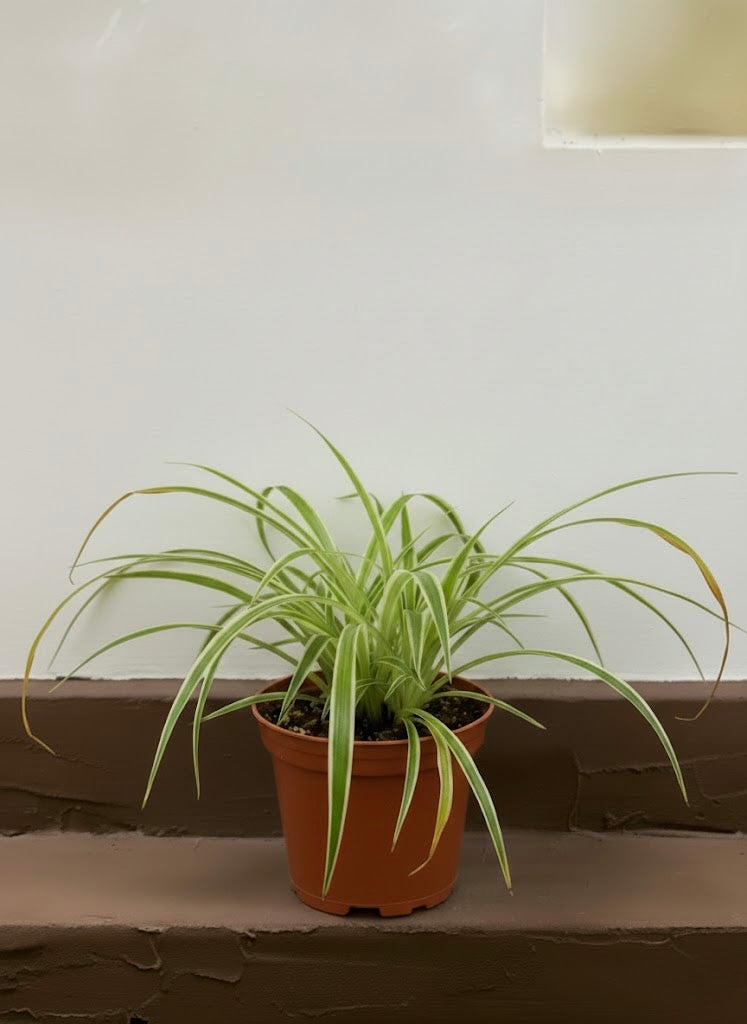
What Pollutants Does Spider Plant Remove?
Based on the NASA study and subsequent research, the Spider Plant has been documented to absorb the following indoor air pollutants:
Formaldehyde — the pollutant for which the Spider Plant ranked among the top three performers in NASA's study. Formaldehyde is emitted by plywood, MDF furniture, carpets, adhesives, and cleaning products — all common in UAE homes and offices. It is classified as a probable human carcinogen and is one of the most prevalent indoor air pollutants globally.
Xylene and Toluene — solvents found in paints, adhesives, varnishes, and printing inks. In UAE homes where new furniture, renovation work, and decorating products are common, xylene off-gassing is a genuine concern.
Benzene — emitted by plastics, synthetic fibres, rubber, and cigarette smoke. A known carcinogen at higher concentrations.
Carbon Monoxide — one of the Spider Plant's most distinctive documented abilities. Carbon monoxide is produced by gas appliances, generators, and combustion — and even at low concentrations it can cause headaches, fatigue, and over extended exposure, serious health effects.
How Does the Spider Plant Actually Clean Air?
The air purification process in Spider Plants — and plants generally — works through two primary mechanisms:
Leaf absorption: The Spider Plant's leaves contain stomata — microscopic pores that open and close to regulate gas exchange during photosynthesis. As the plant breathes in carbon dioxide and releases oxygen, it also absorbs VOCs that enter through the stomata. These compounds are then broken down within the plant's own cellular processes.
Root zone microbial activity: This is actually where the majority of pollutant breakdown occurs. The microorganisms living in the soil around the plant's root zone — bacteria and fungi that colonise the rhizosphere — are highly effective at metabolising and neutralising VOCs that the plant's roots absorb from air that diffuses through the soil. Dr. Wolverton's research indicated that the root-soil-microbe system is responsible for a significant proportion of the plant's total air-cleaning capacity.
The Honest Limitation — How Many Plants Do You Actually Need?
This is where scientific honesty matters — and where the Spider Plant's air purifying reputation becomes more nuanced than the enthusiastic claims that followed the original NASA study.
The NASA study was conducted in sealed 85-litre test chambers — conditions that are quite different from a typical UAE apartment. When researchers have attempted to scale the findings to real-world room sizes, the numbers become less dramatic. Some analyses have suggested that to meaningfully reduce indoor VOC levels in a standard living room, you would need a very large number of plants — far more than a typical household keeps.
However, several important counterpoints make the picture more optimistic than these calculations suggest:
First, the root zone effect means that pots of plants — particularly those with exposed soil and active microbial communities — purify air more effectively than the leaf surface area alone suggests. A well-maintained Spider Plant in healthy soil is doing significant purification work below the surface.
Second, Spider Plants grow quickly and prolifically, producing multiple spiderettes that can fill a room with a significant combined leaf and root surface area within a year or two. A collection of 8–15 Spider Plants in a UAE home — entirely achievable given how easily they propagate — provides meaningfully more purification than a single specimen.
Third, in UAE homes specifically, indoor air quality is a genuine concern. Sealed, air-conditioned environments with limited fresh air exchange accumulate VOCs from furniture, cleaning products, and building materials faster than homes in more temperate climates with natural ventilation. Any reduction in these compounds has proportional health benefit.
The UAE-Specific Air Quality Context
For UAE residents, the air purification question has particular relevance. UAE homes and offices are among the most completely sealed indoor environments in the world — air conditioning runs continuously, windows remain closed for most of the year, and natural ventilation is minimal. This creates conditions where VOCs and indoor pollutants accumulate with less opportunity to naturally dissipate than in more temperate climates.
Common sources of indoor air pollutants in UAE homes include:
- New furniture and fitted wardrobes (formaldehyde from MDF and plywood)
- Fresh paint and renovation materials (VOCs from solvents)
- Cleaning products (benzene, ammonia, and other chemicals)
- Synthetic carpets and rugs (formaldehyde and xylene)
- Air fresheners and scented candles (VOCs)
- AC system recirculation (concentrating rather than removing indoor pollutants)
A collection of Spider Plants — alongside other documented air-purifying plants like Peace Lily, Snake Plant, and Pothos — contributes to reducing these accumulated pollutants in a sealed UAE indoor environment, even if the reduction is modest at the scale of individual plants.
Beyond Air Purification — The Wider Health Benefits
The science on Spider Plants extends meaningfully beyond VOC removal — and in some respects, these additional benefits are more robustly demonstrated than the air purification claims.
Hospital recovery study: Research from Kansas State University found that surgical patients in rooms with Spider Plants and other houseplants recovered measurably faster than patients in rooms without plants — requiring less pain medication, experiencing lower anxiety and blood pressure, and being discharged sooner. This suggests that the psychological and physiological benefits of plant presence extend beyond air chemistry.
Humidity contribution: Spider Plants release water vapour through transpiration — a modest but genuine contribution to indoor humidity. In UAE homes where AC routinely drops indoor humidity to 20–30%, any increase in localised humidity is beneficial — particularly for skin, respiratory health, and the health of other indoor plants nearby.
Psychological wellbeing: Multiple studies have documented that the presence of indoor plants reduces stress, lowers cortisol levels, improves mood, and increases reported life satisfaction. The Spider Plant's cheerful, cascading appearance and the satisfaction of watching it produce spiderettes and new growth contribute to this wellbeing effect. For UAE residents spending significant time in sealed, air-conditioned apartments, this psychological benefit is genuinely meaningful.
Noise reduction: Plant foliage — particularly in groups — absorbs and diffuses sound waves, providing a modest acoustic buffer in hard-surfaced UAE apartment interiors where sound echo and reverberation can be significant.
The Balanced Verdict
The Spider Plant is genuinely one of the best-documented air-purifying houseplants available — NASA's research and subsequent studies have consistently confirmed its ability to absorb formaldehyde, xylene, benzene, and carbon monoxide from indoor environments. The honest caveat is that a single plant makes a modest contribution to air quality in a full-sized room, and the dramatic claims sometimes made about houseplants as standalone air purifiers are overstated.
The realistic, evidence-based position is this: a collection of Spider Plants — combined with other well-documented air-purifying plants and adequate ventilation where possible — makes a genuine, cumulative contribution to improving indoor air quality in UAE homes. It is not a replacement for air filtration systems, but it is a meaningful complement — one that also brings humidity, beauty, psychological wellbeing benefits, and the practical joy of a plant that thrives effortlessly in UAE conditions.
How to Maximise Air Purifying Performance in UAE Homes
To get the most air purifying benefit from your Spider Plant in UAE conditions:
Use multiple plants. A single Spider Plant makes a modest difference. A collection of 5–10 spread across your living space makes a substantially more meaningful contribution to air quality. Spider Plants propagate easily from spiderettes — one plant becomes many within a year.
Maintain healthy soil. The root zone microbes are responsible for a significant proportion of VOC breakdown. Healthy, well-aerated soil with a rich microbial community — not compacted, mineral-saturated UAE tap water soil — is essential for full air purifying performance.
Switch to distilled water. UAE tap water's fluoride and mineral salts damage root health over time, reducing the plant's overall vitality and its air purifying capacity. Distilled water or AC condensate keeps roots healthy and soil microbial communities active.
Add a pebble top dressing. A layer of pebbles from GrowHub's gravel and pebbles collection on the soil surface maintains good airflow at root level, supports healthy soil microbial activity, and keeps the plant display looking beautifully polished.
Place in areas of highest pollution concern. Position Spider Plants near new furniture, freshly painted walls, or in rooms with limited ventilation — the areas where VOC accumulation is highest and the plants' contribution is most meaningful.
Final Thoughts
The Spider Plant's air purifying credentials are real — documented by NASA, confirmed by subsequent research, and particularly relevant in the sealed, AC-cooled indoor environments of UAE homes. The honest picture is that plants are not a substitute for ventilation and air filtration, but they are a genuine, evidence-based complement — one that also brings humidity, beauty, wellbeing benefits, and effortless resilience to any UAE indoor space.
For a plant that is non-toxic to pets, virtually impossible to kill, extraordinarily easy to propagate, and documented by NASA as one of the top air-purifying plants available, the Spider Plant makes a compelling case for its place in every UAE home.
🌿 Shop the Spider Plant at GrowHub — healthy, UAE-suited Spider Plants delivered across Dubai and Abu Dhabi.
🪨 Shop pebbles for top dressing — supports healthy soil microbial activity for maximum air purifying performance and gives every Spider Plant display a beautifully finished look.


